
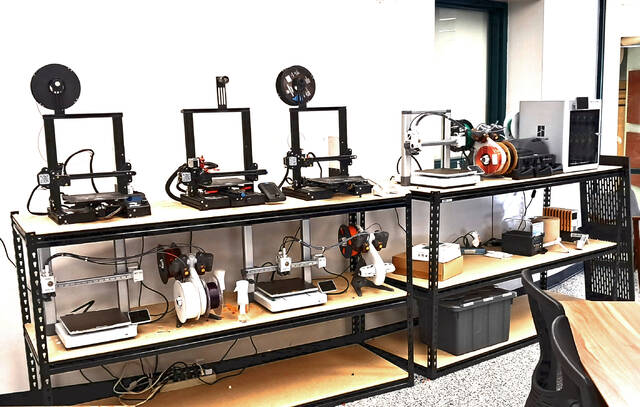
Pictured are the 3D printers in the Forge Lab that students will be utilising as part of the Engineering CTE that will be offered at West Union High School. (Photo by Ryan Applegate)
By Ryan Applegate
People’s Defender
When the school bell rings at West Union High this fall, a new sound will join the familiar hallway chatter and locker doors — the whir of 3D printers, the hum of sewing machines, and maybe even the soft buzz of a vinyl cutter at work. It’s the sound of the future, and it’s coming from the Forge Lab, the school’s brand-new makerspace that will serve as the centerpiece of a newly launched Career and Technical Education (CTE) pathway in Engineering.
Assistant Principal Kristin Regenstein says the project has been a long time coming, and the excitement is already spilling beyond the classroom walls. “This is an exciting addition for our students and community,” she said, noting that the lab will offer hands-on learning experiences that blend technical skills with creativity. “We’re proud of the opportunities it will give our students — not just for projects in school, but for skills they’ll carry into careers and life.”
For Aaron McCann, the WUHS teacher responsible for running the Forge Lab, the goal is to make engineering concepts accessible and engaging for students as young as seventh grade. “It’s a program for 7 through 12, where students try to become career ready in skills that involve different concepts of engineering,” McCann explained. “We focus on understanding the engineering design process, problem-solving skills, and using this space to incorporate those into all different curriculum areas — math, science, even social studies.”
The engineering pathway is structured to start with introductory courses in junior high, giving younger students a taste of design and building before they commit to upper-level classes in high school. This year, the high school will offer two engineering classes, with the plan to expand to a full four-year sequence. By senior year, graduates could leave with a CTE Engineering Pathway Seal on their diploma, signaling to colleges and employers that they’ve had deep, specialized training.
The Forge Lab itself is a carefully designed space divided into technology-rich and hands-on craft areas. On the tech side, students will learn both two-dimensional and three-dimensional design, starting with simple projects like making button pins for backpacks or jackets. From there, they’ll move to drafting blueprints and creating digital models using CAD software such as Fusion 360, Tinkercad, or Onshape. Designs can be brought to life on the lab’s seven 3D printers — a mix of McCann’s personal machines and district-owned equipment — and used in class projects or competitions like the Ohio Kids Color robotics program.
That program, a collaboration with Southern State, lets students 3D print robot parts, assemble circuits, wire components, and program microcontrollers. “It’s a full process,” McCann said. “They get hands-on with mechanical, electrical, and coding skills.” Additional technology includes vinyl cutters for custom designs, and embroidery machines — one single-color and one fifteen-color — for more complex projects.
The creative possibilities don’t stop with tech. The Forge Lab also houses four sewing machines, which will come into play for this year’s school musical. Students will help design and build props, as well as create costumes, giving them a chance to merge artistic design with practical construction. “Instead of just a couple of adults making all the costumes, we’ll get the kids actively involved,” McCann said.
A small woodworking shop, complete with dust collection, bandsaw, belt sander, and drill press, offers another dimension of hands-on experience. While the woodworking component is mostly introductory, McCann says it’s about more than building skills — it’s about building confidence. He recalled working with students in a summer outreach program. “Only three had ever used woodworking equipment before,” he said. “They were nervous at first, but once they learned the safety protocols and tried it, you could see their confidence grow.”
Across the hall from the Forge Lab, another project is taking shape: a student-run store. This space will double as a small-scale manufacturing hub where students can design, produce, and sell school merchandise. With tools like heat presses, sublimation printers, and embroidery machines, they’ll be able to create everything from golf team towels to custom mugs and ball caps. The plan is for the first nine weeks of class to be spent designing and renovating the store itself, then staffing it during lunch and free periods.
A mobile kiosk is also in the works for selling products at sporting events and school performances. McCann tested the concept last year with a simple wheeled table at the school musical — the students sold nearly 100 shirts. “It’s not just about making products,” he explained. “It’s about public relations, customer service, keeping track of inventory. These are soft skills that don’t always get taught in a typical classroom.”
For McCann, the real magic will come when students take an open-ended prompt and run with it. “When they have access to all this stuff, it’s amazing what they’ll do,” he said. “Some will do exactly what you assign, and some will just naturally do more — not because you told them to, but because they’re curious.”
That curiosity, paired with practical skills, could have a long-term impact. McCann envisions graduates leaving WUHS not only with technical know-how but with the ability to think creatively and solve problems — traits in high demand across industries. “I think we’re going to have a lot of students leave high school with prerequisite skills to be successful in several different avenues,” he said. “More importantly, they’ll leave with the confidence that they can take on challenges and figure things out.”
And if the sound of that is anything like the hum of a 3D printer or the hiss of a heat press, it’s a sound the West Union community may be hearing for years to come.