
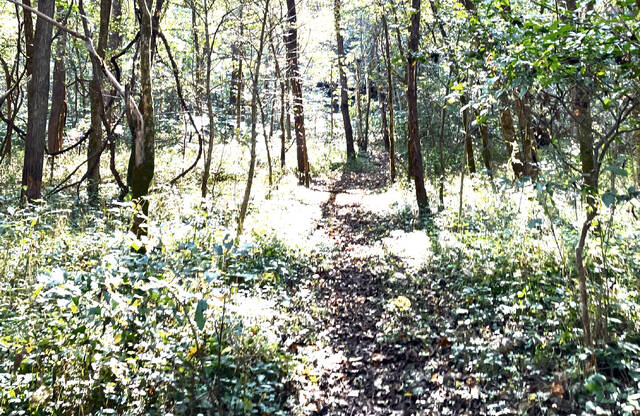
An overgrown walking path is shown at a trail in Adams County during the summer of 2025, one of several concerns raised by residents regarding land management and public access on large conservation properties. (Photo by Ryan Applegate)
By Ryan Applegate
People’s Defender
House Bill 540, currently under consideration by the Ohio General Assembly, has become a focal point of debate in Adams County and other rural areas of the state, where large tracts of land are owned by nonprofit conservation organizations and are exempt from property taxation. The bill has prompted discussion about fairness, local government funding, conservation policy, and the long standing role of charitable tax exemptions in Ohio law.
House Bill 540 was introduced during the 136th General Assembly for the 2025 to 2026 regular session by State Representatives Justin Pizzulli of Scioto County and David Thomas of Jefferson County. As introduced, the legislation proposed creating a new section of Ohio Revised Code, section 5709.122, to require certain nonprofit conservation organizations to make annual payments in lieu of property taxes on land that is currently tax exempt.
According to the bill’s language, the requirement would apply to nonprofit conservation organizations described under section 501(c)(3) of the Internal Revenue Code whose primary purpose is environmental conservation and that own or control more than 15,000 acres of tax exempt land in a single county. Under the original version, the organizations would be required to pay an amount equal to 2.5 percent of the unimproved taxable value of qualifying real property, assuming the land were subject to taxation. Payments would begin in June 2026 and be distributed to local taxing authorities in proportion to what would have been collected through property taxes.
Since its introduction, the bill has been amended. The most recent version removes the direct payment requirement and instead limits the exemption itself. Beginning with tax year 2026, 97.5 percent of the unimproved land value would remain exempt from taxation, while 2.5 percent would be taxable. Improvements on the land would remain fully exempt. While the structure has changed, supporters have indicated that the intent remains the same as the original proposal.
During sponsor testimony before the House Ways and Means Committee on October 29, 2025, Representative Pizzulli framed the legislation as an issue of local responsibility. “House Bill 540 ensures that when nonprofits hold vast amounts of land, they do their part to sustain the very communities that surround and support them,” Pizzulli said. He described the bill as “commonsense legislation that reconciles outdated policy.”
Representative Thomas also emphasized the impact of tax exempt land on local taxpayers. “This is an example of a policy that has contributed to rising property tax bills as we exempt more and more land from being taxed or being added to the tax base,” Thomas told the committee. “This concept could be a step to help lower bills for taxpayers in our rural areas and ensure necessary services are provided in our communities.”
The legislation was inspired in large part by circumstances in Adams County. According to sponsor testimony, one conservation organization owns more than 20,000 acres of land in the county, with nearly $10.9 million in unimproved value, and pays no property taxes on that land due to its nonprofit status.
Adams County Commissioner Jason Hayslip testified in support of the bill during the November 5, 2025 hearing. He described the issue as a long standing concern among county residents. “Since I was a little boy, I have heard conversations and sometimes real frustrations about the large landholdings owned by The Nature Conservancy and the fact that they pay no property taxes,” Hayslip said.
Hayslip stated that while conservation is valued, the fiscal impact of large tax exempt holdings is significant. “While these lands are exempt from property tax, this organization earns revenue through carbon credit programs, and their operations support high paying employees who benefit financially,” he said. “Meanwhile, the people I represent, farmers, homeowners, and small business owners continue to pay their fair share to support our schools, fire departments, local 911, EMS services and law enforcement and all local services to keep our community safe.”
He described the issue as one of fairness rather than opposition to conservation. “This is not an opposition to conservation,” Hayslip said. “We all appreciate the beauty of our county and the importance of protecting it for future generations. But this is about fairness. It is about ensuring that everyone who benefits from our county’s land also contributes to the wellbeing of the community that supports it.”
Adams County Auditor David Gifford also submitted testimony supporting the legislation. In his written statement, Gifford provided updated figures for the 2024 tax year, stating that “the total real property tax revenue not charged due to exemption for The Nature Conservancy and the Cincinnati Museum of Natural History amounts to $391,596.” Of that total, $332,440 was attributed to The Nature Conservancy and $59,156 to the museum.
Gifford explained that the impact goes beyond the loss of annual revenue. “From an auditor’s standpoint, the continued expansion of non taxable acreage makes long term financial planning increasingly difficult,” he wrote. “Each tax year, the share of tax exempt land grows while the cost of county services continues to rise.”
He added that when large tracts are removed from the tax base, “the burden shifts to a smaller pool of taxpayers, often leading to higher effective rates and uneven millage adjustments.” Gifford stated that in a rural county like Adams County, this instability can quickly affect service delivery for schools, townships, and emergency services.
Property taxes in Adams County increased by approximately 20 percent for tax year 2026, a fact that was reported by Gifford during the January 5, 2026 Adams County Board of Commissioners meeting. This increase has intensified local concern about the size of the tax base and the distribution of tax responsibility.
Opposition testimony was presented during the November 19, 2025 hearing. Bill Stanley, State Director for The Nature Conservancy in Ohio, testified against HB 540, stating that while the organization recognizes the fiscal challenges faced by Adams County, it believes the bill takes the wrong approach.
“We understand that Adams County faces fiscal challenges and remain committed to working collaboratively toward a solution that is both sustainable and mutually beneficial,” Stanley said. However, he argued that “state legislation that targets a single tax exempt organization is not an effective or appropriate course of action.”
Stanley emphasized the role of tax exemption in nonprofit work. “Property tax exemptions for charitable organizations are granted on the basis that the organizations provide significant benefit to the public,” he said. He described The Nature Conservancy as “a charitable non profit 501(c)(3) with a mission to conserve the lands and waters on which all life depends,” and stated that this mission delivers value to Ohio and Adams County.
Stanley also cited voluntary contributions made by The Nature Conservancy. “Though we are not required to pay taxes, we have been making annual voluntary contributions to townships for many years,” he said, noting that the organization provided $17,111 in voluntary payments to seven Adams County townships in 2024. He also referenced the Edge of Appalachia Adams County Community Fund, which awarded $100,000 in grants and scholarships in 2025.
Addressing estimates of potential tax liability, Stanley said, “We believe that the estimates that have been included in sponsor and proponent testimony overstate the tax amounts that we would be liable to cover if we were not tax exempt.” He explained that much of the land would likely qualify for Current Agricultural Use Value forest classification, adding, “At the rate paid under this example, our total tax liability would be approximately $43,000 per year.”
Stanley also highlighted economic and recreational benefits, stating that “the Edge of Appalachia Preserve plays a key role in making Adams County a tourism destination,” with approximately 13,000 visitors annually. He said that TNC provides “2,400 acres and 100 free hunting permits reserved for only Adams County residents” and participates in educational programs and community events.
Carol Kauffman, Chief Executive Officer of the Ohio Environmental Council Action Fund, also opposed the bill. “One of the things that makes our country great is our support for not for profit organizations,” Kauffman wrote. She argued that HB 540 “creates a damaging precedent regarding the alteration of Ohio’s code relating to the various tax exemptions that are currently on the books.”
Kauffman acknowledged local funding challenges but stated, “There are different terms used for what HB 540 attempts to impose, taxes, fees, or PILOTs, however the result would be the same, diverting nonprofit resources away from their mission and into government accounts.”
As HB 540 continues to be considered, residents in Adams County have raised concerns about land ownership, property values, land management, and tax equity. Supporters of the bill argue that requiring large landholders to contribute financially would help stabilize local budgets and ease pressure on homeowners and farmers. Opponents maintain that conservation organizations already provide significant public benefit and that local agreements, rather than statewide legislation, are the appropriate path forward.
The House Ways and Means Committee has not yet taken further action on the bill. The debate surrounding House Bill 540 continues to reflect broader questions about conservation, taxation, and the fiscal sustainability of rural communities in Ohio.