
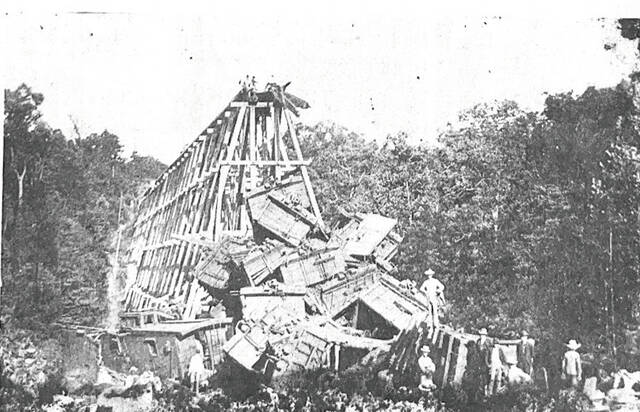
(By Stephen Kelley from the Peoples Defender, 1981)
Adams County businessmen tried to encourage railroad transportation into the county for several decades before success was ever achieved. Several railroads were planned and discussed by various business groups and corporations beginning as early as 1853. More than once county residents read in their newspapers about a new railroad being built into the county only to be disappointed when the well laid plans were scrapped for
one reason or another. Perhaps the railroad would have come into Adams County much sooner had it not been for the perpetual municipal bickering between West Union and Manchester. Years before the Civil War, these two rival villages were sabotaging each other’s schemes to secure the passage of a railroad line into their respective communities. Ironically, neither town ever succeeded, the only line to be built in the county passing through the northern quarter of Adams County. It has been stated many times that West Union is uniquely the only county seat in Ohio not serviced by a railroad.
It was in 1877 that the iron horse finally made it into Adams County. In that year the Cincinnati and Eastern Railroad was extended from Macon in Brown County to the village of Winchester in the northwestern corner of the county. Winchester remained the terminus of the railroad until 1881 when work resumed to stretch the rails to Portsmouth. This was hilly terrain and many road fills, cuts and trestles had to be constructed. The project was so immense that it was 1883 before the first locomotive steamed its way from Cincinnati to Portsmouth. The largest of the trestles built for the railroad in Adams County was over Shimer Run just a short distance west of Peebles. It was a wooden structure that extended near a 500 feet in length and towered 90 feet at its highest point above the small creek.
The trestle was an engineering feat and in a short time became a well known landmark. Construction on the trestle was apparently completed in late 1881 allowing trains to travel as far as Peebles by 1882.
Although erected to carry narrow gauge trains, the trestle was forced to withstand much larger standard gauge trains beginning in 1885. As larger and heavier trains were put on the line, many local residents started worrying about the safety of using the fragile looking Shimer Trestle. Their concern was apparently shared by the Norfolk and Western Railroad Company which purchased the line in 1901. Although there was nothing formally announced by N & W, it was generally believed that plans were on the drawing board to renovate or replace the aging outdated structure.
Tragedy occurred early on the morning of August 2, 1902. It was a few minutes past 5 o’clock as a double header freight train pulling twenty-five loaded coal cars slowly approached the Shimer Trestle from the east. Engine No. 280 led way, coupled with engine No. 250. After the front locomotive had crossed the center of the trestle, disaster struck.
The aging hand hewn timbers could no longer withstand the tension and several beams started splintering under the tremendous pressure. Within seconds several coal cars started dropping as dead weight through the collapsing structure, pulling the rest of the train into the same abyss. When engineer Clark of the lead engine felt his locomotive stopped by an unseen force then being dragged backwards, he immediately realized old Shimer was giving way. Keeping his cool, the experienced engineer without hesitation rammed the throttle wide open.
As the train cars pitched downward into calamity and destruction, the surrounding hills and valleys reverberated with the thundering noise. Within minutes, dozens of residents from Peebles and nearby farms were on the scene. One of the first to arrive was Peebles photographer, David Gardner, camera in hand.
Leave a Reply