
By Ashley McCarty
People’s Defender
Long before Mineral Springs became known for its ccurrent ampground, it was a large, bustling community all its own, nestled in sprawling valleys and abundant forests.
With the Ordinance of 1787, the territory northwest of the Ohio River was opened for settlement. Despite the Shawnee Natives which inhabited the area – and who were officially at war with Caucasian settlers – a group of adventurers entered the region and began surveying the area.
The first survey in what was to be called Adams County, Ohio, was made by John O’Bannon in November 1787. O’Bannon, Nathaniel Massie, Arthur Fox, Duncan McArthur, George Vinson Haller and other prominent individuals risked their lives daily to survey the virgin wilderness of southern Ohio.
These surveyors were the first to discover and note the presence of bubbling springs with mineral water in the northeast quarter of Adams County.
In 1840, Charles Matheny with his friend, John C. Beasley, was hunting a tract of land in Meigs Township owned by Elias Matheny. Dry Fork of Turkey Creek cut through the valley, fed by the numerous mineral springs flowing from the base of Peach Mountain.
Matheny, who suffered from a kidney disorder, drank from one of the springs and quickly discovered the cleansing effect it had on his renal system. Deciding the mineral waters may be the answer to his medical woes, he returned to the area later and constructed a small log dwelling. In a few months, his symptoms were gone.
News of this cure traveled quickly, and soon, many others were visiting the springs in hopes of banishing their various ailments with the alleged remedial effects the waters possessed. As the years progressed, more and more people came to the springs. So burdensome were these visitors that Elias Matheny sold his land to relative W.W. Matheny in October 1857.
With similar sentiments, W.W. Matheny sold the 34-acre property to Hillis Rees in April 1863. The first owner to capitalize on the property, Rees erected a two-story log hotel in 1864, just a few hundred feet south from the largest of the springs.
Thus, the Mineral Springs Health Resort was born. Rees named this new resort “Sodaville.”
Later, Rees sold Sodaville and 32 acres to Byington Salisbury, Adam H. McFerson and James McFerson in November 1866 for $6,000, over 500 percent of what he had invested less than four years prior. Incorporated as Salisbury, McFerson and Co., the trio bought an additional 10 acres from W.W. Matheny in November 1867 and 390 acres from L.E. and Eliza Jane Cox in April 1868.
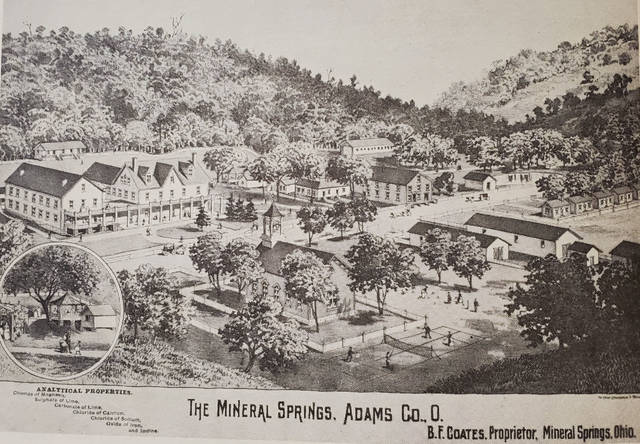
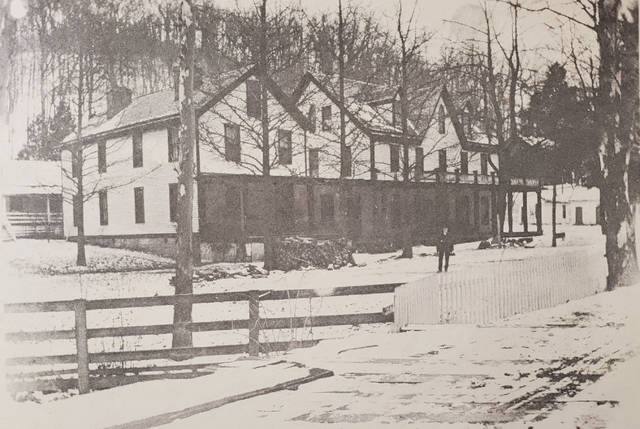
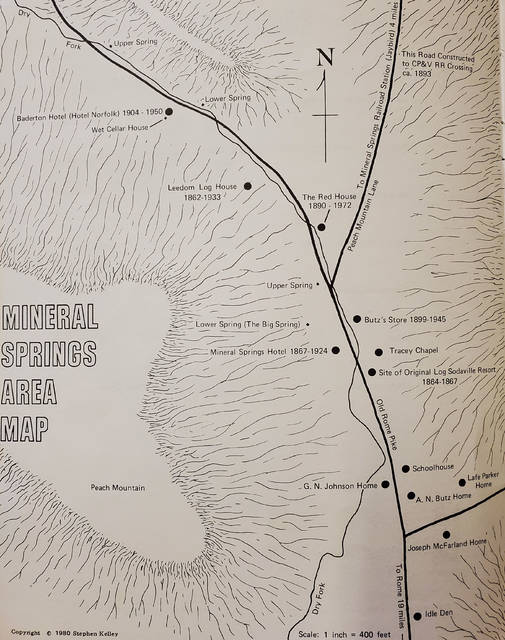
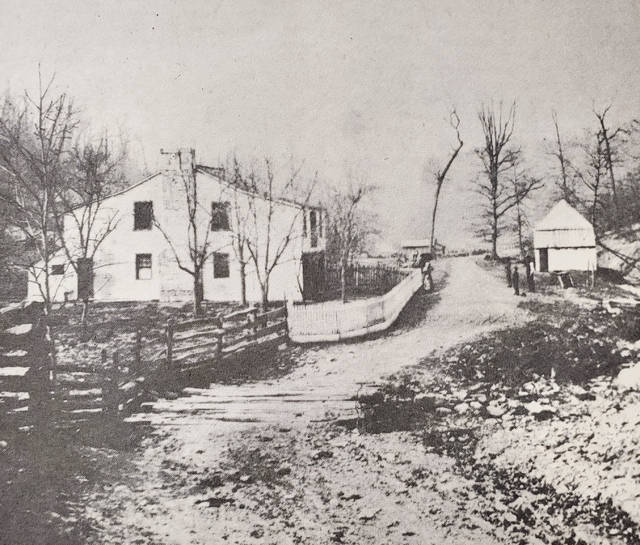
Immediately after purchasing Sodaville, the company tore down the log hotel and replaced it with a large two-and-a-half-story frame hotel in 1867. The hotel was located a few yards south of the large spring Charles Matheny drunk from nearly three decades before.
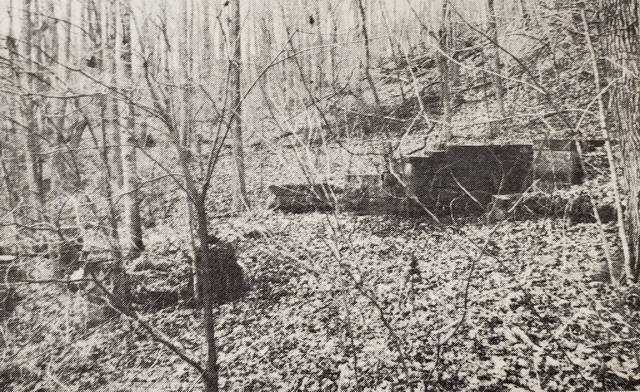
The company built stone improvements around the spring and another spring a few hundred feet north. These were known as the Lower and Upper springs, respectively.
The company also built a number of rustic cabins behind and beside their hotel for visitors who wished to save money. Hiking and bridle trails were laid out over the resort’s dense and plenteous acreage.
As business increased, a post office was established in 1872; Salisbury was appointed the first postmaster. The post office was located in the hotel and was named Mineral Springs. As time passed, the name Sodaville quickly withered as the resort and surrounding community adopted the same name as the new post office.
In October 1873, the community had its first church. A small tract of land across from the hotel was deeded to the trustees of the Presbyterian Church, and under the auspices of the Portsmouth Presbytery, a small-framed, brown capel was constructed.
In the early years of the resort, most guests visited by way of steamboat to the village of Rome, Ohio. From there, they were chartered by horses operated by the resort. In 1881, a new mode of travel was instituted as the railroad crept into the territory. In 1882, the first station was built in the vicinity at the community of Beaver Pond.
After falling into financial difficulty, Salisbury sold his one-third interest in the resort to his partners in the 1870s. After 1880, the McFersons opened up a general store in the hotel that stocked dry goods, groceries and footwear.
In May 1888, the McFersons sold the resort with 427 acres to General Benjamin Coates of Portsmouth, Ohio, for $11,000.
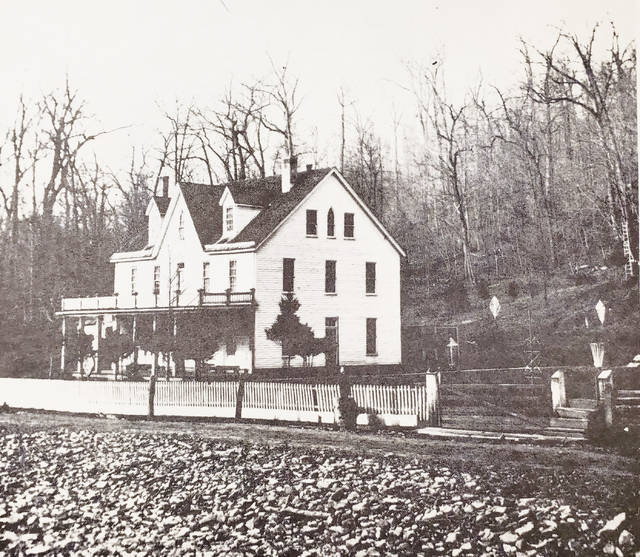
In his three years of ownership, Coates invested heavily in the resort and made many improvements. Coates built an additional 20 rooms on the south end of the hotel, a large two-story frame structure north of the hotel, moved the general store to the first floor and constructed a red, two-story home on the grounds for himself.
This red home stood until it was torn down in 1972.
Across from the hotel, barns were built to house livestock. Large gardens were planted, which produced an abundance of vegetables; pigs, beef, dairy cattle and chickens were raised on the grounds. An ice house with walls nearly 3ft thick was built to store ice cut from the Ohio River. Coates’ made the resort a self-supporting entity.
During these years, along with hiking and horseback riding, guests had the option of playing tennis on new courts behind the chapel or playing croquet on the lawns. A small, spring-fed pond for fishing was excavated, and spring visitors could now lounge in the shade of gazebos built beside them.
In June 1891, Coates sold Mineral Spring to George Davis, who promptly sold it to Smith Grimes. Grimes hired Frank Hemmings, local stonemason and carpenter, and had stonework around the springs improved. In the basin of the spring, Grimes had his name carved.
Around 1900, Grimes erected a substantial amusement hall for dancing, bowling, billiards and other festivities. In 1906, he built a two-story frame structure on the side of the hill behind the hotel. The ground floor contained an up-to-date bowling alley, while the second floor, a spacious open room, was furnished as a theater.
This structure collapsed in 1979.
Grimes also included new tennis courts and croquet grounds. Before 1895, Grimes donated $1,000 to help in the construction of a new road over Peach Mountain to the railroad at Jaybird. Upon completion of the road, the station was moved from Beaver Pond to Jaybird.
The station was known as Mineral Springs Station until closing in the 1920s. It was also during Grimes proprietorship that the resort obtained telegraph and telephone connections.
In 1904, a Cincinnatian and experience hotelkeeper named Robert B. Mills built a new two-story frame hotel. Mills purchased a six-acre tract from J.L. Eldridge in September 1902. This land was a quarter-mile north of the Mineral Springs Hotel. January 1905, Mills purchased an adjoining 40 acres from T.S. and Ruey Eldridge. Soon after, Mills had a third spring excavated nearly the hotel with a small wet-cellar house erected over it.
In March 1910, Mills sold to Alfred C. and Eugenia Bader. Upon purchase, Alfred immediately renamed the hotel to The Hotel Baderton. The Hotel Baderton also had small log cabins available.
In January 1908, Grimes sold the Mineral Springs Hotel with 430 acres to J.W. Rogers and Frank Durnell of Hillsboro, Ohio, for $17,000. Rogers had an additional story-and-a-half built onto the hotel and Coates’ adjoining addition. The hotel had 110 rooms, filled to capacity during the summer months. With the need for more space, an annex was built on the southeast corner of the hotel in 1912 containing an additional 12 rooms. Later, the annex was enlarged to 25 rooms.
At its largest, the hotel with cottages could accommodate 300 people.
In January 1916, the Bader’s sold the hotel to Minnie Foster of Hamilton County, Ohio. Foster renamed the hotel to Hotel Norfolk.
1905 to 1917 saw the height of popularity for Mineral Springs. It was common to have guests from New York to the deep south and even as far as California. During this time, the automobile made its appearance.
As World War One came to a peak in 1917 and 1918, the prosperity and success of the resort were dealt a staggering blow. Although the hotels suffered, both owners, perhaps hopeful, kept their properties through the war years.
Soon, however, Foster sold the hotel on Dec. 1918 to Nora E. Miller of Alabama. Rogers held onto the Mineral Springs Hotel until 1920, when in March he sold the hotel and 430 acres to Louis Moore and Beu Jamison of Fayette County, Ohio, for $25,000.
The property jumped hands in rapid succession as each proprietor quickly realized they were purchasing a white elephant. In February 1924, Ernest Ramey of Columbus, Ohio, purchased the resort and operated it only during the summer months. Each season, the hotel and its rooms continued to fall further into disrepair.
The gardens, once lush and fruitful, grew tangled with weeds and the stock barns were mostly vacant and unused.
On April 30, 1924, the hotel caught fire. The community could do nothing but stand and watch helplessly as the 57-year-old behemoth slowly burned to the ground. Later, local residents located charred pieces of the hotel as far as two miles away in the surrounding hills and valleys.
Ramey made no effort to rebuild the resort and sold the acreage in less than a year to Cliff M. Switzer of Columbus, Ohio. Subsequent owners either dismantled the remaining structures or permitted them to deteriorate. Over a month before the fire, Ramey had sold the standing timber to Floyd McCoy of Peebles, Ohio.
Hotel Norfolk persisted for a few years, though ravaged by time, war, and poor ownership suffered the same fate of degradation. In 1946, hope for the hotel came when Foster Morgan, Sr., purchased the hotel. He began to restore the buildings and grounds to their original condition.
When Morgan died unexpectedly, the hope was lost. After Morgan’s death, the property was purchased in August 1949 by McCoy. The hotel was regularly vandalized, and the McCoy’s could find no insurance company that would offer them coverage. Seeing no other alternative, they had the hotel torn down in 1950 and the material used in constructing new buildings for their McCoy Lumber Company in Peebles, Ohio.
As of press time, it is currently not known whether the property still resides in the McCoy family.
On Oct. 18, 1981, the Adams County Historical Society and the Ohio Historical Society held a dedication of the Mineral Springs historical marker.
In the current year, habitants of the long-forgotten community mourn for the history lost to time and reclaimed by nature. Bethany Allen, 32, is one of those residents.
“My family on my father’s side is from Mineral Springs. The Johnson’s have been here for upwards of 200 years, but it’s not just about the history of my family. It’s the history of all the families of Mineral Springs, and all the families that have benefited from Mineral Springs. It’s a wonderful and miraculous thing what these people believed in when they took the journey to be healed here. It astounds me. As a kid, I never really invested in that thought, but being older now, I see what the importance of that was. I want people to understand the history and what these people relied on for their hopes and dreams,” said Allen.
Allen doesn’t want the community to forget its past — this goes for all of Adams County.
“We have little places in this county that played major parts in our history that need to be remembered. Being so young, generations my age or younger are not being taught our local history anymore. It’s important that we provide that, or it’s going to be lost. The older generations that have been involved or have heard their parents or grandparents talk about our history are almost gone. If we don’t preserve our history and its understanding, we won’t have a history or a past to look at anymore, because we won’t have the story to be told,” said Allen.
Leave a Reply