
By Rachael Grove
Did you know Ohio has a native cactus population and sand dunes? The Eastern Prickly Pear (Opuntia humifusa) has an established formation right here in Adams County along the Ohio River in Sandy Springs. It is part of the Rock Run Preserve owned by the Arc of Appalachia. Formed by ancient glacial activity during the Pleistocene epoch, glacial floodwaters from the Ohio River deposited massive amounts of sand in the region and gusty winds shaped the sand into dunes, which are still visible today. This is one of the primary regions for Prickly Pear in the state. The cactus thrive in the sandy soil and relatively mild winters. There is also another region in the northwest area of the state around Kitty Todd Nature Preserve and Oak Openings Metro Park.
I also have a small patch of Prickly Pear established in my yard. They really don’t require any maintenance, which is a plus for me. You do need to take special care when weeding around them though. Along with the long spikes, they also have small, hairline prickles called glochids that adhere to skin after detaching from the plant. They have a tendency to get through gardening gloves that even have a rubber coating on them. They are very hard to get off your skin because the glochids are so small you can hardly see them.
According to Wikipedia, in 1961, Cuba planted an eight mile barrier of the cactus along the northeast section of the 17- mile fence surrounding the Guantanamo Bay Naval Base, dubbed the “Cactus Curtain” to stop Cubans from escaping Cuba to take refuge in the United States. The cactus are invasive in Australia, Ethiopia, South Africa and Hawaii. Native Americans and Mexicans primarily used Opuntia as a coagulant for open wounds, using the pulp of the stem. The cactus is also on the Mexico Coat of Arms.
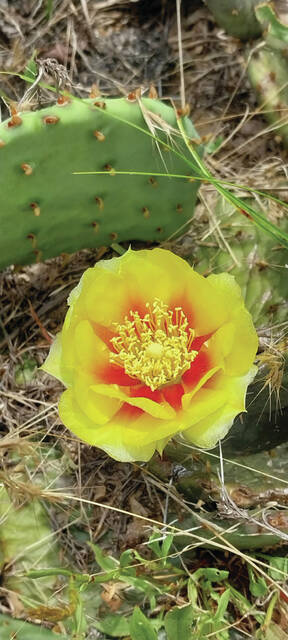
The flowers of the Prickly Pear have beautiful yellow petals with orange in the middle.(see photo). The pads of the cactus are edible and are often used in Mexican and Mediterranean cuisine and are likened to green beans or bell peppers. The flowers can be steeped and used to make tea and jelly. Personally, I have never eaten them but I look forward to their blooms every year.
On my recent hike to Sandy Springs, numerous wildflowers were observed as well such as white yarrow, yellow sulphur cinquefoil, yellow primrose, deptford pinks, purple Venus looking glass, white soapwort and yellow hopclover. In addition, Black oak, Sassafras and Mulberry trees were noted. I couldn’t help but eat a few of the berries. I also observed some old Chantrelles on a tree stump.
John Howard, our guide for the hike, also found several Geolycosa wolf spider tunnels in the sand. These are small wolf spiders that dig deep cylindrical holes and build low turrets with sticks around the edges at the top. John encouged one to poke its head up for us to observe after pushing a few grains of sand into its burrow with a stick. It only fell for that once.
We also noticed several Silver-Spotted Skippers along the way and got to witness their behavior of depositing a single egg on the leaf of their host plant, a black locust. I was surprised at how fast this all happened and I actually found several single ovaposits. Although very small, about the size of a pinhead, they’re white so they stand out on a green leaf.
If you are interested in attending other Arc of Appalachia events, check out their website and click on the Education Calendar tab. You can also hover over the tab to find Exploration Days at a low cost. There’s lots out there to explore. Enjoy!
Leave a Reply