

By Rachael Grove
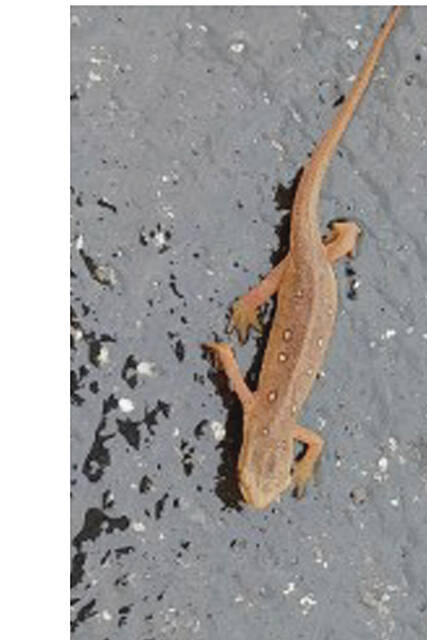
Hopefully, the snow is over for the season. I am starting to hear chorus frogs and Spring peepers. Recently, I have seen the first red eft of the year on our driveway trying to find warmth on a recent chilly day (see pic). A red eft is a juvenile of the Eastern newt, characterized by their orange-red skin and small black-outlined dots on the side of their body. They bred in late winter to early spring. Females lay 200-400 eggs singly, on submerged vegetation. After a few months, they leave the water and live on land for three to five years before returning to the water to live as an adult.
Red efts can be found on the roadside on wet days or by flipping over rocks and logs. If you do find one by that method, be sure to carefully replace the object back to it’s original place. All stages of the species secrete toxic substances through the skin so they are avoided by fish and other predators. With all the rainy weather lately, there are many other salamanders to be found as well.
Also, a few early blooming flowers have already emerged, like the winter aconite (Eranthis hyemalis) that I spotted recently (see pic). These naturalized bulbs have large yellow flowers that will blanket the ground. The genus words come from “er” meaning spring, and “hyemalis” meaning winter or winter blooming. In addition, the common Snowdrop (Galanthus nivalis) has been up for awhile often poking through the snow. The genus words “Galanthus” is derived from the Greek word for milk, and “nivalis” meaning “of the snow”. They are a member of the amaryllis family native to Europe. They consist of white, bell-shaped fragrant flowers that produce nectar and the green markings inside may act as a guide for pollinators. Ants are attracted to their seeds, which may encouage them to take the seeds away and bury them.
The flowers close as the earth rotates and the sunlight fades, which is why I had a hard time photographing it. Being such an early bloomer, Snowdrops are a crucial early food source for bees and other insects. Snowdrops can bloom for up to one month, so get outside and see if you can spot any before they are gone for another year.
Leave a Reply