

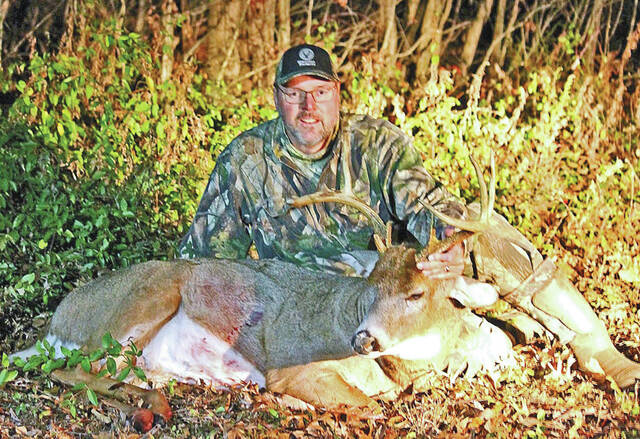
Ohio’s deer gun season opens November 28, runs through December 4, and returns again during the “Bonus Season”, Dec. 17-18. This weekend however Ohio’s youth gun season kicks in with young hunters having a go at it this Saturday and Sunday, November 19-20. If bowhunting this weekend you are required to wear orange, same as you would during the regular deer gun season.
While archery season got off to a fast start, things have slowed down a bit, the statewide total bow kill as of November 8 stood at 52,792. Last year (2021) at this same time bowhunters had tagged 56,668 deer, representing a slight decrease of 7 percent.
In Adams County, bowhunters had harvested 822 deer as of November 8, of which 436 are bucks and 386 are antlerless. That represents a 17 percent decrease from the same date last season (2021).
If you’ve been in the woods much you probably notice the overly abundant acorn mast crop under your boots. According to ODNR, an average of 39 percent of white oaks and 37 percent of red oaks bore fruit this year. From my observation, acorn mast has been particularly good in Adams County the last seven or eight years. I can remember some years in the past when nary an acorn could be found, which in turn drove the deer to the farm fields to feed which made bowhunting a little easier. Now with acorns so abundant the deer have to travel very little to feed, perhaps contributing to the lower archery harvest numbers. ODNR says the long-term average for white oak production is 37 percent of trees will produce mast and for red oaks its 54 percent of trees will produce mast, so it appears the red oak mast is down for this fall.
“A mature oak can produce thousands of acorns,” said Department of Wildlife Chief Wecker. “In addition to deer and squirrels, 90 percent of forest dwellers feed on acorn throughout the fall and winter.”
Although it is said that deer prefer white oaks, the woods I hunt in are full of red oaks and I observe deer feeding equally under white oak and red oak trees.
Southwest Ohio has had a particularly nasty outbreak of EHD (Epizootic Hemorrhagic Disease) with cases confirmed in 13 counties by the end of August, including Highland, Clinton, and parts of Brown and Clermont County. Although no confirmed cases in Adams County, the northern part of the county that shares a border with Highland has reported numbers of dead deer with Bratton Township being hit the hardest.
Keith Hoop, who owns a farm that straddles Bratton and Franklin Townships, has found two dead deer on his farm. Other dead deer he’s heard of locally include does, fawns, and an 8-point buck. “I had seven bucks staying on my farm all year, they all disappeared. In August I found two dead, I have seen just two bucks since then.”
EHD is caused by the bite of an infected midge (a type of fly). Outbreaks are often associated with drought which can result in high deer mortality in some areas.
Deer have little resistance to EHD and are likely to die within three days following the onset of symptoms. Carcasses are usually recovered near water and there is currently no treatment for EHD. It does not affect humans nor does it impact the safety of consumed venison. EHD does not pose a serious threat to livestock, according to the Ohio Department of Agriculture.
The long-awaited reopening of the Tranquility Wildlife Area gun range is scheduled for next week, just prior to Thanksgiving. The improvements at the range are impressive, a real addition to the county and a plus for local hunters and shooters.
Leave a Reply