
By Ryan Applegate
People’s Defender
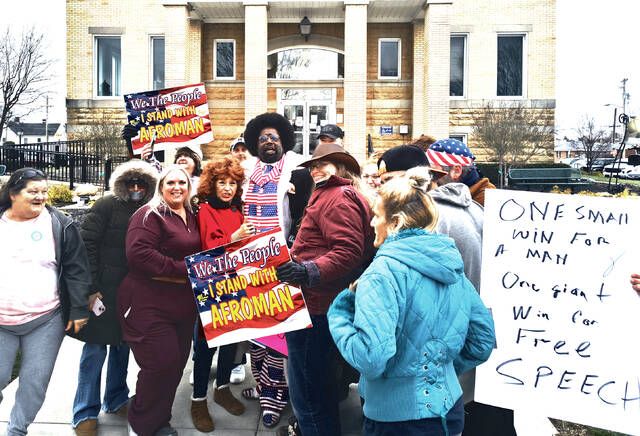
A jury in Adams County Common Pleas Court has returned a verdict in favor of rapper Joseph “Afroman” Foreman, concluding a civil case that has drawn significant local, national and international attention over the past three years.
The decision followed a three-day trial held March 16 through 18 before visiting Judge Jonathan P. Hein. After approximately six and a half hours of deliberation, the jury found in favor of Foreman on all claims, rejecting allegations of defamation and invasion of privacy brought by seven members of the Adams County Sheriff’s Office. The court subsequently entered judgment in favor of the defendant and dismissed the case in full. Court costs were ordered to be divided evenly between the parties, and the ruling was entered as a final appealable order.
The lawsuit stemmed from an Aug. 21, 2022 search of Foreman’s Winchester-area home, where deputies executed a warrant as part of an investigation. Video recorded during that search from inside the home was later incorporated into Foreman’s music video “Lemon Pound Cake” and shared widely across social media platforms. The video quickly gained traction online, drawing millions of views and placing Adams County in the national spotlight. Deputies involved in the search later filed suit, alleging that their images and likenesses were used without consent and that the content subjected them to ridicule, harassment and reputational harm.
Foreman and his legal team maintained that the video and related content were a form of artistic expression and commentary based on his personal experience. Throughout the trial, attorneys for the defense argued that the material should not be interpreted as literal statements of fact but rather as entertainment consistent with Foreman’s work as a musician and performer.
During the trial, plaintiffs presented testimony from multiple deputies who described the impact of the video and related posts. Several testified that they experienced embarrassment, public criticism and emotional distress as the content spread online. They pointed to phone calls, messages and other interactions they attributed to the video’s reach and argued that repeated posting over time increased the harm.
The defense focused on how the content would be understood by a reasonable person. Attorneys argued that music, particularly in the rap genre, often includes exaggeration, humor and commentary, and that listeners do not interpret lyrics or videos as literal fact. Testimony presented by the defense included a witness who stated that the content was generally viewed as humorous and did not personally affect her. Foreman also testified, explaining that he was not present during the search but observed events through his home security system. He described the search as disruptive and said his response was to create music about the experience, which he characterized as consistent with his career.
Before closing arguments, the court issued rulings that narrowed the issues for the jury. The judge determined that the publication of the statements was not in dispute, meaning jurors were not required to decide whether Foreman shared the content publicly. Instead, the jury was tasked with determining whether the statements were false and whether they caused harm to the plaintiffs.
In closing arguments, attorneys for the plaintiffs argued that Foreman knowingly made false statements that harmed the reputations of the deputies and pointed to testimony describing emotional distress and the impact of widespread online attention. Defense attorneys countered that the case centered on the right to free expression and argued that the content reflected exaggeration and commentary common in entertainment. They also questioned whether the plaintiffs had demonstrated clear evidence of damages directly caused by Foreman’s actions.
After deliberation, the jury returned general verdicts in favor of Foreman on all claims. Based on that outcome, the court dismissed the case in its entirety. A request for injunctive relief was also denied, with the court noting it could not stand as a separate cause of action.
Following the verdict, Foreman’s attorney, Dr. David Osborne Jr., issued a statement reflecting on the outcome and its significance. “The Law Office of Dr. David Osborne, Jr. is proud to have represented Joseph ‘Afroman’ Foreman in his Defamation trial. This case and trial have become important to the American people by renewing our faith in the justice system and by re-establishing the American right to criticize our Public Officials. Cases like this build a strong defense for our First Amendment right and affirm the rights guaranteed to all Americans.
“In turbulent times like these we must work together as a community to rebuild the public’s trust in our systems. We must come together to support the best aspects of our institutions and to use this opportunity to fix the broken parts.”
The case has generated attention far beyond Adams County, with coverage appearing in regional and national media outlets and discussion spreading across social media platforms worldwide. What began as a local dispute over a search and a video evolved into a widely discussed legal battle involving questions about speech, public officials and online content.
Observers have noted that the case reflects what is often called the Streisand Effect, a situation in which attempts to suppress or challenge information can lead to increased public awareness and wider distribution. In this instance, the lawsuit itself coincided with increased visibility of the video and related content, bringing additional attention to both the case and the community.
Despite the conclusion of the trial, some local effects remain ongoing. Reports of phone calls to the Adams County Sheriff’s Office and the Adams County Courthouse related to the case continue. Deliveries of lemon pound cakes referencing the song at the center of the dispute have also continued at local offices following the verdict.
The case asked jurors to consider where the line exists between protected expression and unlawful harm. While the jury ultimately found in favor of Foreman, the proceedings highlighted the challenges courts face in addressing speech in the digital age, particularly when content spreads rapidly and reaches wide audiences.
With the verdict now entered, the case concludes at the trial court level unless further action is taken through the appeals process. For Adams County, the decision brings an end to a case that has drawn attention, debate and division within the community. As the legal process closes, local officials and residents are left to move forward following a case that placed the county at the center of a broader national conversation.
Leave a Reply