
By Ryan Applegate
People’s Defender
For many in Adams County, Memorial Day is marked by flags placed beside familiar names in familiar cemeteries. In Manchester, one of those names belongs to a young man whose story eventually became known around the world through the pages of “Band of Brothers,” but whose roots never stretched beyond the hills and river towns of home.
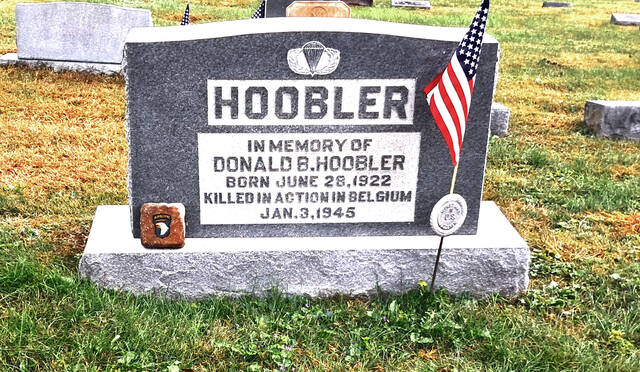
Corporal Donald Brenton Hoobler of Manchester was just 22 years old when he died during the Battle of the Bulge on January 3, 1945, serving with the famed Easy Company, 506th Parachute Infantry Regiment, 101st Airborne Division. More than 80 years later, Hoobler remains one of Adams County’s most recognizable World War II servicemen, remembered not only for his role in one of America’s most storied military units, but for the sacrifices he made long before the cameras and books ever told Easy Company’s story.
Hoobler was born June 28, 1922, in Adams County, the son of Ralph and Kathryn Hoobler. Raised during the years between two world wars, he grew up in a family deeply connected to military service and hard work. His father, a World War I veteran, died when Donald was still a child, leaving behind a family that depended heavily on one another to move forward.
After graduating from Manchester High School, Hoobler joined the Ohio National Guard on October 15, 1940, at a time when war already loomed overseas. A year later, he was sent to Camp Shelby, Mississippi, when the Guard was activated for wartime service. While training there, Hoobler learned of his father’s death and was allowed to return home.
Because of the family circumstances, Hoobler reportedly was given the option to remain home for the duration of World War II. Instead, he chose to volunteer for one of the Army’s newest and most dangerous assignments.
He enlisted in the Army paratroopers.
Alongside fellow Manchester natives Robert “Bob” Rader and William Howell, Hoobler entered airborne training in 1942. The three friends enlisted together at Fort Thomas in Newport, Kentucky, on August 22, 1942, eventually becoming part of Company E, better known as “Easy Company,” in the newly formed 506th Parachute Infantry Regiment.
At Camp Toccoa, Georgia, the men trained under the demanding leadership of Captain Herbert Sobel. The camp became famous for the brutal runs up Currahee Mountain and the punishing physical conditioning that transformed ordinary young men into elite airborne soldiers.
Hoobler trained as a rifleman in 3rd Squad, 1st Platoon. He later earned his jump wings at Fort Benning before the 101st Airborne Division assembled at Fort Bragg and eventually deployed overseas to England in 1943.
In the early morning hours of June 6, 1944, Hoobler boarded a C-47 transport aircraft and parachuted into Normandy as part of the Allied invasion of German-occupied France on D-Day. Like many members of Easy Company, he landed scattered among hedgerows and farm fields under enemy fire in darkness and confusion.
Despite the chaos, the paratroopers regrouped and fought through the Normandy countryside, securing roads, bridges and artillery positions critical to the success of the invasion. Hoobler continued serving with Easy Company during Operation Market Garden in the Netherlands later that year, where Allied airborne troops attempted to seize key bridges deep behind enemy lines.
By the winter of 1944, Easy Company found itself in Belgium during the Battle of the Bulge, one of the bloodiest and coldest campaigns of the war. The men endured freezing temperatures, shortages of winter clothing and relentless German artillery fire while holding defensive positions around Bastogne.
During that time, Hoobler had reportedly advanced into a leadership role as an assistant squad leader. On Christmas Eve 1944, Hoobler reportedly suggested to Sergeant Robert Rader that the two of them take over guard duty that night so other members of their squad could rest as a Christmas gift.
Less than two weeks later, tragedy struck.
On January 3, 1945, Hoobler accidentally shot himself in the leg when a captured German Luger pistol discharged as he crossed a fence. The wound severed an artery, and despite efforts by medic Eugene Roe to save him, Hoobler died from his injuries.
The circumstances surrounding his death later became widely known through Stephen Ambrose’s book “Band of Brothers” and the HBO miniseries of the same name. In the television dramatization, Hoobler was portrayed by actor Peter McCabe, though the series altered details of the accident for dramatic effect.
What remained unchanged was the respect fellow soldiers held for him.
Hoobler’s death deeply affected the men of Easy Company, especially his close friends from Manchester. The same day Hoobler died, William Howell suffered severe shrapnel wounds during combat and required hospitalization. Robert Rader continued fighting despite multiple wounds sustained throughout the war.
Rader later became a teacher in California after the war and contributed memories and interviews used in Ambrose’s research for “Band of Brothers.” Howell eventually returned to Ohio before later settling in Sandusky. Of the three Manchester friends who joined the paratroopers together, only Hoobler did not make it home alive.
Today, Hoobler rests at Manchester IOOF Cemetery alongside members of his family. For local residents, his grave serves as a reminder that some of the young men who fought in history’s defining battles once walked the streets of Adams County, attended local schools and came from ordinary families rooted in southern Ohio.
Easy Company eventually became one of the most famous units in American military history, known for its combat service from Normandy to Hitler’s Eagle’s Nest in Germany. Yet before the books, documentaries and television series, its soldiers were simply young men answering the call to serve.
Hoobler was one of them.
This Memorial Day, as communities across Adams County gather to honor fallen servicemen and women, Hoobler’s story stands as a reminder of both the extraordinary and deeply personal costs of war. He was a son of Manchester who could have stayed home, but instead chose to step forward into one of the most dangerous assignments of World War II.
More than eight decades after his death, Donald Brenton Hoobler’s name continues to endure, not only in military history, but in the community he left behind.