
Submitted by Rebecca A. Rickey
Charles H. Eyre American Legion Post 633
Seaman, Ohio
Early on Feb. 3, 1943, an enemy torpedo struck the Army transport Dorchester as it carried 902 officers and enlisted men, Navy armed guard, merchant seamen and civilian workers in the North Atlantic. The Coast Guard cutter escorts Comanche and Escanaba rescued 230 men.
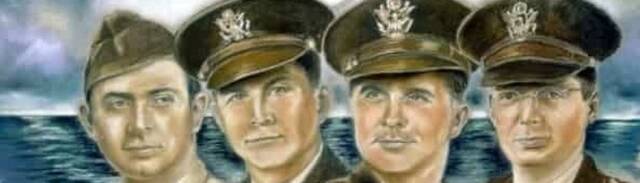
As Dorchester took on water, four Army chaplains – Lt. George L. Fox (Methodist), Lt. Alexander D. Goode (Jewish), Lt. John P. Washington (Roman Catholic), and Lt. Clark V. Poling (Dutch Reformed)– calmed frightened soldiers, aided the wounded and guided the disoriented toward safety.
On deck, they opened a storage locker and began distributing life jackets. When there were no more available, the chaplains removed their life jackets and gave them to four young men. “It was the finest thing I have seen or hope to see this side of heaven,” said John Ladd, a survivor.
As the ship went down, men in rafts saw the four chaplains, arms linked and braced against the slanting deck, singing hymns and praying. Congress attempted to confer the Medal of Honor on the chaplains but was prevented by strict requirements of heroism under fire. It authorized a one-time posthumous Special Medal for Heroism, awarded by President Eisenhower in 1961; it was intended to have the same weight and importance as the Medal of Honor.
Every year, American Legion posts nationwide commemorate the selfless acts of the Four Chaplains on or near February 3, designated Four Chaplains Day by Congress in 1948. Through interfaith services, memorial ceremonies and other solemn events, members of the American Legion Family lead their communities in honoring the chaplains and 668 other men who died when Dorchester sank. Founded in 1951, the Chapel of Four Chaplains in Philadelphia encourages and supports these observances, and recognizes selfless service to community, nation and humanity through its Legion of Honor award program.
Lt. Alexander D. Goode Born in Brooklyn, N.Y., in 1911, Goode became a rabbi like his father. He applied to become a Navy chaplain in early 1941, but was not accepted. After Pearl Harbor, he tried again, this time with the Army, and received an appointment on July 21, 1942. He went on active duty on Aug. 9, 1942, and was selected for the Chaplains School at Harvard. He was assigned to the 333rd Airbase Squadron in Goldsboro, N.C. In October 1942, he was transferred to Camp Myles Standish in Taunton, Mass. He and his wife, Theresa, had one daughter.
Lt. George L. Fox As a medical corps assistant during World War I, Fox was highly decorated for bravery and awarded the Silver Star, Purple Heart and the French Croix de Guerre. Fox studied at Moody Institute, Illinois Wesleyan and Boston University School of Theology. He and his wife, Isadore, had two children. While serving as a pastor in Gilman, Vt., he joined Walter G. Moore American Legion Post 41. He also served as the Legion’s state chaplain and historian. Fox went on active duty Aug. 8, 1942, the same day his son Wyatt enlisted in the Marine Corps. He was assigned to the Chaplains School at Harvard and reported to the 411th Coast Artillery Battalion at Camp Davis in Holly Ridge, N.C
Lt. Clark V. Poling Poling attended high school in Poughkeepsie, N.Y., where he was student body president and a football halfback. He was ordained in the Reformed Church in America and served as pastor of First Reformed Church in Schenectady, N.Y. He and his wife, Betty, had a son, Clark Jr. When America entered World War II, he decided to become a chaplain. Talking with his father, who served as a chaplain in World War I, he learned that chaplains in that war had the highest mortality rate of all military personnel. On June 10, 1942, Poling was appointed a chaplain with the 131st Quartermaster Truck Regiment and reported to Camp Shelby in Mississippi. Two months after Dorchester’s sinking, Betty gave birth to their daughter.
Lt. John P. Washington Born into a poor immigrant family, Washington took a newspaper route to help support his family. He loved music and sang in the church choir. In seventh grade, he sensed a call to the priesthood. Washington attended Immaculate Conception Seminary in Darlington, N.J., where he was ordained a priest in 1935. Shortly after the Pearl Harbor attack, he received his appointment as an Army chaplain. In June 1942, he was assigned to the 76th Infantry Division at Fort Meade, Md. In November 1942, he reported to Camp Myles Standish in Taunton, Mass., where he was reunited with Fox, Goode and Poling – his classmates at Chaplains School at Harvard.