
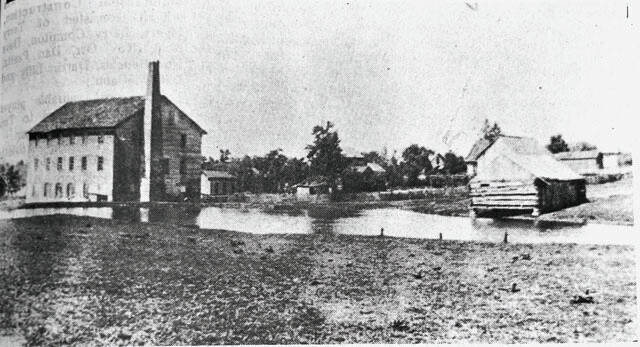
(By Stephen Kelley from the People’s Defender 1983)
Another gristmill that stood in West Union was located on East Main Street where Dr. Howard Colvert’s office sits today. It was a large four-story structure, possibly the largest gristmill constructed in Adams County. It was owned and operated for several years by Henry C. and Sidney P. Stroman and was well known as the Stroman Brother’s Roller Mills.
The Stroman Mill was erected in 1866, not as a mill, but as a woolen factory. In that year, Arthur Clark, John C. Duffey, George McIntire Frederick Shuster, Dr. John Campbell and Arthur Clark formed a partnership and built the West Union Woolen Mills. Here, raw wool was processed into yard goods which were then sent on to city factories that finished them into such items as horse blankets, clothing, etc. The woolen mill was bought in 1870 by another company composed of Edward P. Evans, James McClanahan, Smith Grimes and Wesley Satterfield. These gentlemen operated the mill until 1878 when a national financial crisis forced the business to close.
The mill structure sat idle until 1884 when purchased by the Stroman brothers and converted into a gristmill. The Stroman’s were natives of Lawrence County, Pennsylvania, the grandsons of John Stroman who had immigrated to the U.S. from Switzerland.
Sidney Stroman removed to Adams County with his parents in March, 1861. The following year he enlisted in the 91st Ohio Volunteer Infantry and served in the Civil War unit for over four years. His brother, Henry, chose to remain in Pennsylvania where he enlisted in the 42nd Pennsylvania Volunteers. Like his brother, he served over four years, being discharged in 1865. In 1868, he moved to Adams County where he continued in his profession as blacksmith. Although Henry and Sidney bought the mill as partners, it was Henry who actually managed the business. Sidney was apparently a financial partner only, remaining on his farm north of West Union permitting Henry to run the big mill.
The Stroman Brothers’ Mill was equipped with three sets of stone buhrs and two sets of Odell rolls for manufacturing flour and corn meal. Its machinery was powered with a thirty-horsepower stream engine. Three brands of flour were produced from “home grown grain”:” IXL;’ Fancy and Straight. In 1891, the capacity of the mill was fifty barrels per day.
The Stroman’s apparently ran the mill until ca. 1908. By this time, most mills of this style were shutting down as “store-bought” flour manufacture and distributed by giant firms such as General Mills crowded the hometown mills out of business. It was much easier to travel to the nearest general store and buy a sack of flour or corn meal rather than worry with raising and harvesting your own wheat and corn and taking them to the local mill for processing.
After Henry Stroman’s death in November, 1911, his widow Julia sold the property to Levi B. Stroman, oldest brother of Henry, He, in turn, sold the mill in 1913 to West Union businessman, William “Bill” Bayless. The property than remained in the Bayless family for several years being passed from Bill to his sisters, Edna Abraham and Lizzie Moore. You will remember that Bill Bayless and Edna Abraham also owned the Pflaumer Mill and were wrote about last week.
From 1913 through 1936, the old mill building was used for storage and as a tobacco barn. In early 1937, it was purchased by Ralph and Beatrice Scott who renovated the big frame structure into several apartments with garage space. It was then acquired by Charles H. “Bud” Wilson and Adrian Earhart in February 1939. Shortly after buying the old mill, they razed it to make way for commercial development.