
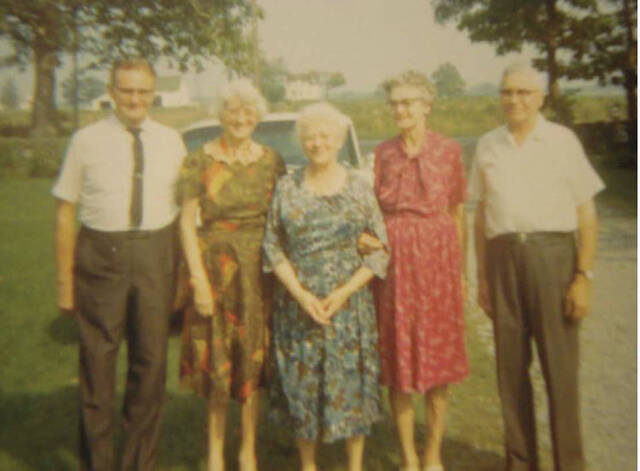
It has been a few weeks since we talked about the Donald “Cargill” (1857-1954) and Elizabeth (Sharpe) (1864-1939) Wickerham family. However, this week we will be sharing a letter written by their oldest son, Idelma “Del” Wickerham to his older sister, Maude Lillian (Wickerham) Kays. You may remember Del was one of Ellis’s playmates. Ellis was little Lena McCoy’s older brother who died at age 14 in 1906, from an acute attack of appendicitis. They were first cousins, as Del’s dad, Cargill and Ellis’s mother, Victoria were brother and sister.
Cargill and Elizabeth lived on the “The Ridge” with their family but being upset with the church at Tranquility moved to Logan County, Ohio in 1908. The following letter describes family worship at the Wickerham’s when their parents (Cargill and Elizabeth) were out of sorts so to speak.
Dear Maude,
Father and mother were both very religious. They were reared in the Scottish Covenanter church and carefully trained by pious parents and preachers of that faith. Two methods of instruction in our family were: (1) “Saying” the Questions, and (2) family worship. By the Questions was meant the Westminster Shorter Catechism which was learned and said every Sabbath afternoon. Family worship was “had” twice every day, presumably morning and evening. Morning came to mean any time before noon: and evening, any time before we went to bed. Exact time was not important, but missing worship was. For instance, one forenoon, we were making hay out in front of the house, mother was on the wagon loading the hay when she happened to remember they had not had worship that morning. She slid down, told father and we all went into the house and had worship.
A certain form was usually followed: praise, Bible reading and prayer. Pa would say, “Pass around the books.” The “Books” consisted of the Bible and enough “Sam” (Psalm) books to go ‘round. Pa would then announce the Psalm, read the two stanzas that were to be sung, repeat the first two lines, then pause. Mother had a good singing voice and always started the tune, almost always, but that comes later. Pa would then read the chapter; then follow by prayer with all of us on our knees. This was done with such unfailing regularity that in the 55 years of father’s and mother’s married life it amounted to something like forty thousand times. The Bible was read “straight through”; and many times, I have seen them move the “mark” from Revelation back to Genesis.
One would be blind indeed if he could not see the value of such consistent example and instruction. While a rigid schedule for devotions had its rewards, it could also create a problem — what to do when worship time came, as it always did, on a day when heads of the family were not speaking, a condition, if known, would have surprised outsiders as ours was considered a very religious family. It only goes to prove that the Bard of Avon was so right when he wrote, “The course of true love never did run smooth.” Would they omit worship; would they make up or what? Neither mother nor father would dare (and I do not call it superstition) face the unknown for one day or one night alone on their own (without God’s blessing).
Mother always taught us children, “Let not the sun go down upon your wrath,” but this time, the sun just went down too quick for Pa. However,
he was equal to the occasion. Without saying a word, he picked up the books: read the two stanzas of the Psalm: repeated the first two lines; and without a pause before mother had any chance, he started the tune! Mother followed along sheepishly while trying to keep her eyes off her children. Of all the many ways a man has of venting his spleen on his spouse, I think father’s is unique. I have known others to do it by slamming the door, ripping the tires or kicking the cat, but no other by “starting the tune.”
Side note – Westminster Shorter Catechism were written in the 1640s by English and Scottish divines. They were to be used by parents to train their children concerning matters of doctrine/belief. The Kirk (the church) on John Knox’s return to Scotland adopted the practice of teaching children the catechism on Sabbath afternoon. There were 107 questions. The questions dealt with Creation, the original sin and the fallen state of man’s nature, Christ the Redeemer, Ten Commandments, Sacraments of Baptism & Holy Communion and to teach and explain the Lord’s prayer.
Del Wickerham’s two older sisters (Inez and Maude Lillian) married and moved to Kansas. His younger sister, Edna married and lived in Columbus, Ohio. Donald, the youngest married and lived in Xenia, Ohio. Del married, remained on the home farm in Logan County, Ohio where he died in 1988 at the age of 97.