
The Killing Times- Part 1
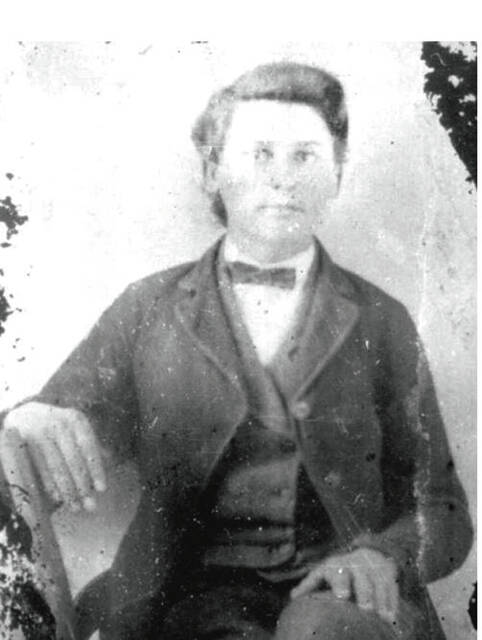
Many of our previous stories were written about John Milligan Wickerham, his wife Eleanor (Ralston) Wickerham and their family. John and Eleanor had eleven children but of those only four grew to adulthood. Of those four Candace only reached the age of 31, dying of an abscess on her kidney in 1883. Of the other three children Lois Ann (Aunt Lou) remained somewhat of an invalid and never married, Nancy Victoria “Tori” who married Andrew McCoy, suffered from severe rheumatism and moved with her family south to Texas to try and find some relief and Donald Cargill their only living son married but in 1908 removed with his family from “The Ridge” to Logan County, Ohio.
Donald “Cargill” Wickerham (1857-1954) grew-up with his three sisters on “The Ridge” a small farming community just south of Tranquility in Adams County, Ohio. Donald attended school at the Lower George’s Creek school house (I think it was #4) on George’s Creek. George’s creek is a stream which rises in the central portion of the Scott Township and flows into the West Branch of Brush creek near Lawshe. It was named for a family named George who settled on the banks of the creek below Tranquility, in the early days.
Donald Cargill Wickerham was named in honor of Donald Cargill,(1619-1681) one of the many ministers martyred during what was called the “Killing Times,” in Scotland. I want to stop here and give you a little history to help you understand why Covenanters were so determined and steadfast in their faith.
In 1660, King Charles was restored to the English throne and annulled the Church of Scotland as Presbyterian and forced the Church of England upon Scots. The Scottish National Covenant was declared unlawful and seditious. Many ministers left their parishes and held out-of-door prayer meetings called “Conventicles”. People also met in small groups called societies with laymen conducting worship services. When the people would not comply with the new laws, increasing penalties were introduced for e.g., absence from the Church of England on three successive Sundays involved a fine and to preach at a field Conventicle was made punishable by death.
In 1678, a body of 8,000 Highlanders, called the Highland Host was unleashed upon Ayrshire, an area north and west of Glasgow, Scotland. They were given free quarter; in other words, they were allowed to support themselves by looting the land and the people. This led to open revolt. The people were defeated in armed attacks and routed in battle at a place called Bothwell Bridge in June 1679. Prisoners including ministers were hung.
Donald Cargill was a minister and at first tried to bring peace between the King and the people, but after seeing how the people were being treated, he knew his efforts were pointless. He soon saw the evil within these men for the want of power and control over the Covenanters. The Covenanters believed that Christ was the head of the church and refused to swear that the King was the head. The Scottish people were driven to holding their meetings in secret. Donald was one of the field ministers who was not afraid to preach the “Good News” at these meetings. This was a time of great persecution of God’s people, thus it became known as the “Killing Times.” These martyr’s names were thus etched in the minds
of all Covenanters young and old. “The Cloud of Witnesses,” a book of testimonies of those who suffered for the truth was thus read cover to cover by all Covenanter children. No one ever walked into a Covenanter household that didn’t see a copy laying along-side the family Bible.
Next week will see what life was like for Donald Cargill Wickerham growing up on “The Ridge” (Nichols Ridge).