




By Ashley McCarty
In this week’s “Unsung Heroes,” we unwrap the package that is the local US Postal Service.
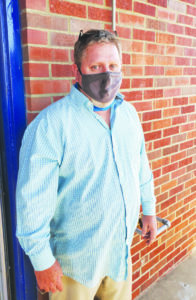
In Manchester, Postmaster Terry Himes has served with the United States Postal Service since 2005. His career path to postmaster started when he became a city carrier in Walnut Hills, Ohio.
“I transferred to Avondale, carried there for a little while, and then got into a management program called the Associate Supervisor Program. I came to Maysville as a supervisor, then took the postmaster position at Russellville,” said Himes.
During his time as a postmaster Himes filled in at a lot of postal offices, such as Ripley, Bethel, Batavia, and Sardinia.
“Then when Ripley actually opened up I took that position. Cathy Pfeffer was the postmaster here, but she actually lived in Ripley and I lived in Bentonville, so I said, ‘Kathy, why don’t you just go to Ripley and take that one, and I’ll come to Manchester?’ I came here, and she actually had to retire. When she retired, she was the postmaster of Manchester, so I got Manchester,” said Himes.
The position of postmaster is akin to a managerial position. Himes oversees the productivity of the mail room, performs secretarial duties, handles payroll, answers customer complaints, remedies personnel issues. and answers emails.
“I’m only as good as they are. If you have great people, it’s pretty easy for you. I’m very fortunate. I’m lucky — I’m lucky basically all over. I’m actually the commander of the VFW, and I’ve got great people over there. These people — you know in bigger city offices it’s a union management thing. Here, we’re family. We take care of each other. They’re all great,” said Himes, tearfully.
While his office hours are 8 a.m. to 1 p.m. and then 2-5 p.m., Himes is on call 24/7.
“If we’re gone and a truck can’t get in to get the mail, I have to come back. If somebody has an accident, I go get that. I’m usually the first one here and the last one to leave or I walk out with the last one,” said Himes.
According to Himes, postal service has evolved over the years to embrace packages more than letters. Letter mail is becoming almost non-existent, he said.
“That used to be the life and breath of the postal service 30 or 40 years ago. People don’t write letters anymore, most people pay their bills online. There’s very few things that come. So, in that sense, the postal service thought that packaging was going to be our way of life from now on,” said Himes.
The increasing popularity of packages and thus the decrease of letters found letter-sorting machines replaced with package-handling machines.
“Then COVID-19 came along, and the election. People were saying we couldn’t handle ballots because we took out all the letter-sorting machines, which is not true. They logistically handle it in a way that if Cincinnati didn’t have letter-sorting machines to handle it, they would send it to Columbus, Columbus would sort it and send it back. That type of thing. That’s not necessarily the scenario that happened, but they looked at it, how we can handle it logistically, and we did fine,” said Himes.
When COVID-19 first hit and the postal service was bombarded with an influx of packages, the postal service wasn’t ready, he said.
“We didn’t expect it. Who knew everybody was going to be at home and on their computer and ordering everything? It overwhelmed us. This time of year we’re ready for it, because we know it’s Christmas, it upticks, but in April and May that was tough,” said Himes.
Postal service has also evolved to embrace the convenience of online employment, now choosing to do their hiring online.
“Used to be, if we had a job opening, I actually interviewed you, now I don’t. You’ll apply online, they’ll take the highest scores, and start down. Not know you at all. I may not even hear from you until the day you walk in and you’re hired. It makes it tough. Other than [one employee], I got to pick all of these people, might be why I got a great staff. Maybe I just got lucky,” Himes said, laughing.
Under the employ of the Manchester branch is Greg Penny, a rural carrier for four years.
Penny’s journey to becoming a carrier began when he got sick.
“I worked at the school as a custodian for several years, and then I got sick. I ended up basically disabled. After I recovered some, there was a job opening here, and I figured it was something I could do that wouldn’t be as tough on me with my disability. It’s a good job, these are good people. Part of what makes it a good job is everybody that I work with, they’re just exceptional people, even beyond what they do here in the post office,” said Penny.
He attended the Rural Carrier Associate Academy, where he received four days of classwork, and training to properly case mail and learn sequences. After that, he attended LLV training to learn how to operate the postal vehicle.
Once in the office, the trainee shadows as they learn routes, and receive hands-on training driving the LLV and delivering mail. Now, a day for Penny starts at 8:15 a.m., where he spends a hectic morning hustling to get mail sorted and into his vehicle.
Once he leaves the office, he has the daunting task of delivering mail on a long route; when he first leaves, he heads out on State Route 136 and into Bentonville.
“I take State Route 41 on out to Suck Run, then Stanfield Road, then I come back out on State Route 41, turn around at Roush Hill, come back toward Bentonville, go up Roush Hill, run all of Cabin Creek back through Bentonville and back into town, then I go up to Cemetery Road, Linda Vista Drive, Cedarview Drive there in town, plus the apartments, then I head out and get the school, get that end of town on State Route 52 to the carryout and turn around and head out toward Rome,” said Penny.
Penny makes it nearly to Rome on State Route 52.
“I get Germany Hill Road, State Route 247 as I come back out, then I come back in Brush Creek Road to Waggoner Riffle Road, Moore’s Run Road, Pumpkin Ridge Road, Gift Ridge Road, Paulette Lane, come back around, head down Bat Roost Road, hit the end of Moore’s Run Road, and come back into the office at that time,” said Penny.
That’s about 90 miles and over 600 boxes, including apartment boxes.
“The biggest stress is time. Trying to get in and out and back in before our truck comes. We’re the last drop in the morning and the first pick up in the evening. So, we don’t have much play there to have a problem on a route, because you’re trying to make up time all day long, and we have to get back before the truck goes up, because people’s mail is top priority,” said Penny.
One thing he wishes people knew about the postal service is that it’s not just throwing mail.
“We’re not lazy. People think you’re lazy because we don’t always knock on your door. At this time, during the pandemic, we try to avoid contact because we want to keep our customers safe, cause we never know what we come in contact with. We also don’t care who you vote for. People complain about the mail and voting, people messing with their mail — we don’t care. We just care that you vote. Like I said, it’s more than just throwing mail,” said Penny.
Despite how demanding and sometimes stressful the job is, Penny finds his greatest reward in the toughest time of year — Christmas, and delivering those presents waiting to be eagerly unwrapped.
“That’s the biggest thing, is making sure that the public has the trust in us to get what they’ve ordered to them in a timely manner and not torn up. When you see families and you know that they struggle, trying to make sure that they have a good Christmas, cause you see a lot of it, you do,” said an emotional Penny.
In West Union, Jennifer Bennington has been a rural carrier for 20 years, wielding a badge of honor as a fifth generation postal employee.
“So, it’s been like a tradition in my family to carry the mail. Not many people can say that, let alone in entire history of the post office, but right here in the county,” said Bennington.
Twenty years ago when Bennington applied for the position, she had to take a test and pass with a certain percentage before being called in for an interview.
“If the interview and the testing score were good, we were hired and then we went to what they call a Rural Carrier Training Academy. It was three days of training at this academy, and then we were thrown in here. Once we got here, we got at least 24 hours of training once we came into the office. Sometimes you’re required to get a little bit more, because it’s all about memorization and organization,” said Bennington.
Bennington’s day starts at 8 a.m., when she comes in to start casing mail.
“What is not already put in order for me, so I put that up first. Next, I proceed to my packages and get them all kind of organized, and then go out and load the vehicle. I get that organized again so I won’t get too messed up through the entire day out there. It’s mainly organization,” said Bennington.
Her route starts on Westview Drive and into Pandhandle.
“Then I take a right on State Route 136, go almost to Cherry Fork, then come back and start on Chapparal Road. I have all of Chapparal, the schools, I have all that. My route is kind of cut up a little bit. After Chapparal, I go through town and then start on East Walnut Street, so I have a little bit of town mixed in my route, too,” said Bennington.
She delivers a little bit in town, before going down to Owens Road and Gabbert Subdivision.
“From there I leave and go to Logans Lane, which is the last part of the right. Start at Logans Lane and work my way over to State Route 41, come up by the lake, and do some of Page School Road. That’s where I end at,” said Bennington.
That’s 660 mailboxes and businesses.
“I don’t think a lot of people realize how organized we have to be in that vehicle to complete the day successfully, because we can misplace something, or something fall somewhere else. You go to get that, and you don’t have that for them, so you have to be on top of it to stay organized out there,” said Bennington.
Sometimes it feels as if there is not enough time in the day to complete the route, she said.
“The hard days, the ones that are the most stressful, it just feels like there’s not enough time out there to complete it. That gets kind of stressful, because you want to complete your route every day, that’s the main goal of this job; get everything done, completed and delivered. Sometimes you lose time here and there with the bigger packages and stuff, and it kind of sets you back a little bit, so then you’re stressed to make that time up,” said Bennington.
Sometimes you lose time no matter what, she said.
“Consequences would be a later day, out after dark, and it’s not easy. [We have to complete our route no matter what.] After dark it’s a lot harder,” said Bennington.
The most rewarding part of being a rural carrier for Bennington is her customers.
“Some customers — I love them and they love me. I have some awesome customers out there, and they make that day easier and more enjoyable,” she said.
Austin Cross, also with the West Union branch, has been a city carrier for two years.
“I did go to college, and I got my Bachelor’s Degree in Marketing and then while I was still in school I had got a job at the post office and I was able to do that here and there because most of my classes were online,” said Cross.
After he graduated and earned his degree, Cross admitted he didn’t mind what he was doing. On top of that, he and his wife are natives of Adams County.
“A lot of our family is out here, so in my mind it’s a good job, so I was like, well, I’ll stay out here, because if I use my degree I’ll most likely have to commute at least an hour and a half or so. More than I probably want to right now. My father-in-law knew Jody, and I kind of got in contact with him and it just happened they were hiring at that time. I put in my application, we did a test, I went to training, and here I am,” said Cross.
Cross also attended RCA Academy, where like Penny, he underwent both instructional training in a classroom setting and LLV training.
At 7:45 a.m., Cross begins organizing early mail from Columbus. He proceeds to organize his cases and packages by address. For Cross, this is the most stressful part of his day, ensuring the proper organization of his mail.
“My typical route, I’ll start my morning at the courthouse, then move over to panhandle to those businesses over there; then I’ll do a lot of residential areas near Lafferty Funeral Home, then carry over by Speedway, do all those businesses, kind of mostly the businesses on Main Street, and some residential. I think I got most of the businesses on my route, so mostly businesses and then some residential, and the courthouse,” said Cross.
Cross said it is easy to misplace a letter.
“Some people don’t realize that the mail is not always perfect. Sometimes they’re stuck together. It’s very easy to misplace a letter attached to another one, or you look down real quick — because I mean, most people may think you walk up to a box and you’re standing there and now you’re organizing the mail — no, they want you to have the mail ready before you get to the box, so it’s really easy to be walking, reading and then set the wrong one in there. I just wish people knew it’s really easy to mess up. It’s not that we can’t read, it’s just easy to make a mistake,” said Cross.
As a city carrier, Cross finds parking to deliver packages and homes where small children and large dogs reside a stressful part of his job.
“If I have a package for someone that’s maybe on Main Street for example. I’m thinking, okay, where am I going to park to deliver this thing? Of course, people with big dogs and small children. Children don’t understand — if they see the mailman, they may rush to the door and open the door — and out comes the dog. So, if I know someone has a big dog and a little kid it makes me uneasy,” said Cross.
The most unusual thing Cross has ever experienced as a mail carrier has been an individual crawling through the lawn with a two by four.
“Their grass was pretty tall and I saw a man out in the lawn crawling with a two by four just to try and flatten the grass, I guess, to make it easier to walk to the house. There was no sidewalk or driveway. That was really unusual for me,” said Cross.
Like Bennington and most carriers, Cross finds the relationship with his customers part of the reward.
“Not to say that the young people don’t appreciate me, too, but I have a couple of elderly people on my route that really make my day. I have one lady on Washington Street that always has candy in her mailbox for me. She always comes out and gets her mail; she can barely make it to the door, but she’ll come out and get her mail and talk to me, say God bless you and ask how I’m doing. It’s moments like that that really make me like what I’m doing, it’s the interaction with the people,” said Cross.
In this trying time of COVID-19, Cross hopes that the community continues to get through it.
“It’s a tough time, and of course we’ll keep delivering the mail. I know a few people in Adams County are suffering from COVID-19 right now, and just prayers for them, and prayers for everybody to make it through,” he said.